Walking Through the Mirror of Time: The Malaysian PIO Narrative in a Moment of Bilateral Reflection

Launch and Publication of the 2nd PIO Studies Journal
November 11, 2025
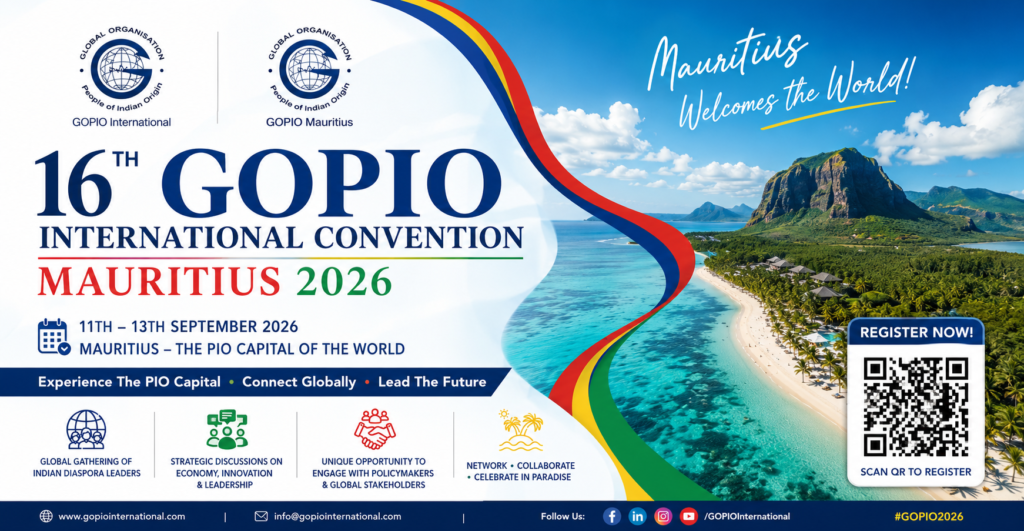
16th GOPIO International Convention 2026, to be held in Mauritius from 11–13 September 2026.
June 15, 2026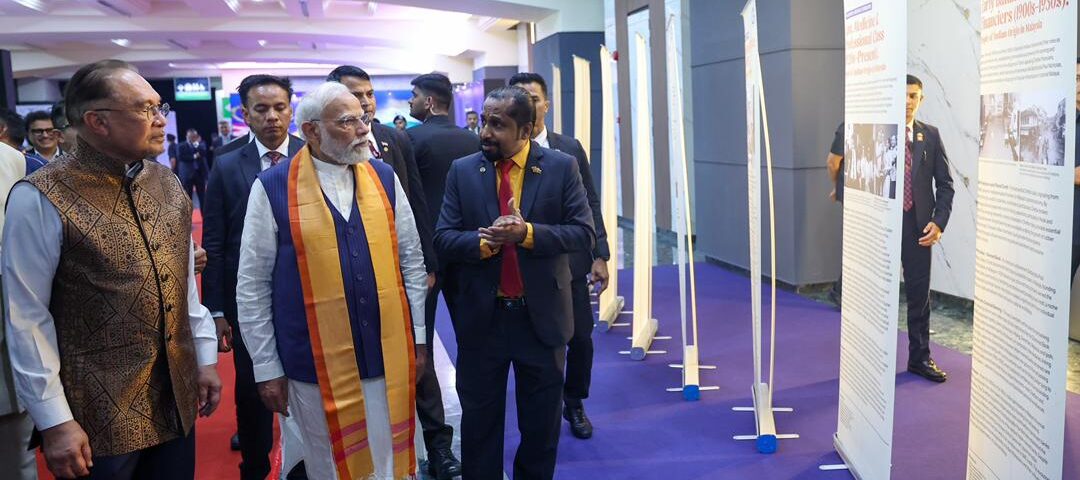
On 7 February 2026, the secured corridor of the Mines International Exhibition and Convention Centre (MIECC) became, for a brief interval, a space of considered historical reflection. Along its walls stood eighteen curated panels reflecting the documented journey of the Malaysian People of Indian Origin (PIO) from 1786 to 2026 (240 years).
Within minutes, the corridor would receive Yang Amat Berhormat Dato’ Seri Anwar Ibrahim, Prime Minister of Malaysia, and Honourable Shri Narendra Modi, Prime Minister of India. The encounter was part of a wider programme of bilateral engagement. Yet within that formal framework, the exhibition offered a quiet opportunity to situate community memory within the context of diplomatic dialogue.
Prepared through collective research and collaboration, the exhibition did not seek to elevate sentiment. Its purpose was more measured: to present documented history with clarity, dignity and constitutional awareness. As I stood beside the panels, I felt conscious not of personal role, but of custodianship that for a few minutes, I would be entrusted to articulate a narrative shaped by generations.
The Threshold of History
At 5.45 p.m., both Prime Ministers arrived and were escorted into the VVIP holding room adjacent to the exhibition corridor. Shortly thereafter, the security formation adjusted, and the doors opened.
The two leaders proceeded with composed deliberation, accompanied by close security. In that instant, high-level diplomacy intersected with community history. I was acutely aware that what would follow would last only minutes, yet represent generations.
My heart quickened not from nervousness, but from the awareness that precision matters when history is being entrusted to the present.
Recognition and Shared Place
As the entourage paused, His Excellency B. N. Reddy, High Commissioner of India to Malaysia, introduced the presentation. It was His Excellency’s recognition of the importance of presenting the Malaysian PIO narrative, including his earlier expression of interest during the October visit, which was subsequently postponed. His Excellency was instrumental in ensuring that the exhibition formed part of this significant bilateral occasion.
I greeted Prime Minister Modi and welcomed him to Malaysia. At the mention of GOPIO, he responded simply, “Oh, GOPIO.” The acknowledgement was brief, yet it carried recognition of sustained diaspora engagement across years.
Turning to Prime Minister Anwar Ibrahim, I offered a respectful greeting and mentioned that I was from Bukit Mertajam. With characteristic warmth, he remarked that Bukit Mertajam “produces very intelligent people.”
The exchange was light, yet meaningful. Shared geography momentarily dissolved the formality of the setting.
Civilisational Continuity and Documentary Care
The presentation began with the introduction of Indians to Penang in 1786 under British administration. As I spoke, I was mindful that the timeline stretched further back. Bukit Mertajam is home to the Cherok Tokun inscription, a 1,500-year-old post-Brahmi-pre-Pallava lithic relic. Time did not permit elaboration, yet the awareness of that deeper civilisational continuum remained present within me.
I explained that between 1786 and 1957, approximately four million Indians arrived in Malaya, of whom around one million settled permanently. Prime Minister Modi paused at several archival photographs and inquired about their origin.
“Where are these photographs from?”
The question was careful and evidentiary. I clarified that many dated back to the late nineteenth century. In that brief exchange, I sensed the quiet importance of documentation that memory must be anchored in evidence if it is to stand confidently within state spaces.
We moved through panels detailing plantation labour, railway construction, clerical administration and the emergence of early professionals in law and medicine. I summarised the establishment of Chettiar financial networks, labour movements and the continued presence of temples, Gurudwaras and Tamil media institutions.
At the Tamil Schools panel, I noted that 528 Tamil schools remain active today. As I spoke the number, I felt the weight of what it represented: generations who insisted that education endure.
A Solemn Chapter
The tone shifted at the Siam–Burma Death Railway panel.
“This is a painful chapter,” I said. Between sixty and seventy-five thousand Malayan PIOs were forcibly conscripted during the war. Many did not return.”
Silence followed. It required no amplification.
At the panel featuring Netaji Subhash Chandra Bose, Prime Minister Anwar gestured towards the image. I added that approximately forty thousand Indians from Malaya and Singapore joined the Indian National Army, situating Malaya within the wider arc of India’s independence movement.
As we continued walking, I felt conscious that these histories of sacrifice and conviction deserve to be spoken with care, not rhetoric.
Constitutional Values and Shared Principles
As the presentation concluded, I recited the five principles of the Rukun Negara. I did so deliberately, aware that these principles form the moral and constitutional foundation of Malaysia’s plural society.
I then briefly explained that the Malaysia MADANI framework introduced by Prime Minister Anwar Ibrahim builds upon those same principles, emphasising sustainability, prosperity, innovation, respect, trust and compassion.
Prime Minister Modi responded with a simple acknowledgement: “MADANI.”
The exchange was brief, yet I sensed that it reflected a mutual recognition of values that civilisational heritage and constitutional pluralism need not stand apart.
After the Walk
As the leaders proceeded towards the main hall, the corridor returned to its formal cadence. Yet something had shifted. The exhibition had been received attentively and respectfully.
Later, Prime Minister Modi acknowledged the exhibition in his official address. It was conveyed by a Special Officer from the Prime Minister of Malaysia’s Office that Prime Minister Anwar regarded the exhibition as demonstrating that the Malaysian Indian narrative is central, not peripheral, to the nation’s history.
Hearing that, I felt not pride, but relief that history had been presented faithfully. It had been understood in the spirit in which it was offered.
The Architecture of Recognition
The five-minute walk through that corridor illustrated a simple principle: when a community documents its history with discipline and presents it with humility, recognition need not be sought; it arrives naturally.
On that day, the Malaysian PIO narrative was not framed as grievance nor as nostalgia. It was presented as a contribution. The transition was subtle yet meaningful, from migration memory to acknowledged nation-building partnership.
The presence of Prime Minister Anwar Ibrahim affirmed that the Malaysian Indian story forms part of Malaysia’s constitutional and plural fabric. His engagement underscored inclusion within national identity.
The engagement of Prime Minister Narendra Modi reflected his longstanding articulation of the diaspora as a living bridge between nations. The exhibition provided a tangible illustration of how that bridge has functioned within Malaysia, through labour, service, sacrifice and institution-building.
From an institutional perspective, the collaboration between the High Commission of India in Kuala Lumpur and GOPIO Malaysia demonstrated how diplomatic and community efforts can operate in complementary roles. The exhibition stood not as an assertion, but as a shared presentation of documented history within a framework of mutual respect.
For the Malaysian Indian diaspora, the walk symbolised dignified visibility. Generations of effort were acknowledged quietly, within the presence of national leadership. Their story did not require embellishment; it required accuracy.
Such moments should not remain exceptional. In plural societies, community histories deserve thoughtful representation within high-level engagements, sometimes through formal exhibitions, sometimes through brief acknowledgements or carefully curated references. When memory is presented with evidence and humility, diplomacy becomes more human, and national narratives become more complete.
As the corridor cleared and protocol resumed, I remained aware that the space had briefly carried more than movement. It had carried memory.
History had been spoken carefully. It had been received respectfully. And for a moment, the past and present had walked together.
Acknowledgement of Contributors
The exhibition presented on 7 February 2026 was the outcome of a collective effort and careful stewardship.
Special appreciation is extended to His Excellency B. N. Reddy, High Commissioner of India to Malaysia, whose encouragement and support made it possible for the exhibition to be incorporated into the official programme of the Prime Minister’s visit.
Special appreciation is also extended to En Mohd Ainuddin Ahmad Hilmi, Special Officer (International), Prime Minister’s Office, Putrajaya, for his constructive engagement and facilitation in conveying relevant feedback following the presentation. His professional courtesy and coordination are gratefully acknowledged.
The initiative was undertaken under the leadership of Mr Gunasakaran Sreerangan, President of GOPIO Malaysia, whose institutional direction provided both mandate and continuity.
Diplomatic coordination and protocol interface were facilitated by Mr Naveen Ramakrishna, whose guidance ensured that the presentation was conducted with due respect for state procedure.
Scholarly guidance and intellectual counsel were extended by Professor Dr Ravichandran Moorthy, Advisor to the Academic Committee of GOPIO Malaysia, whose perspective strengthened the analytical coherence of the exhibition framework.
The historical framework and evidentiary integrity of the panels were shaped through the archival discipline and research oversight of Lt. Col. (R) Annbualagan Chengottayan and Ms Dharmashaktini Arjunan, whose commitment to historical accuracy ensured that the narrative rested upon a substantiated record rather than recollection.
The visual articulation of the exhibition was thoughtfully curated by Mr Thavaseelan Ganesan, whose design translated complex historical material into a clear and dignified presentation.
Operational coordination was managed with composure and precision by Ms Naantheniy Allenjeswaran, ensuring seamless alignment between planning and programme flow.
The exhibition thus reflected not the work of an individual, but a shared commitment to presenting the Malaysian PIO narrative with responsibility, documentation and respect for constitutional and diplomatic order.
The corridor has long since returned to its ordinary function, yet the memory of that brief encounter remains a reminder that history, when responsibly curated, can speak quietly within the highest forums of state.
Sashidharan Santhesegaran
Vice President,
GOPIO Malaysia.
Note: Picture courtesy of the Ministry of External Affairs / High Commission of India